Dressed to Disappear: The Activists Who Made Invisibility Their Armor
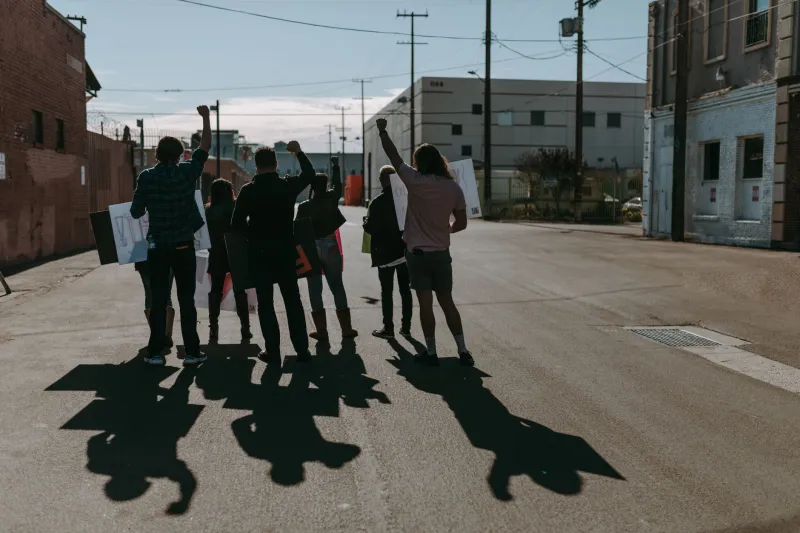
There's a version of resistance that gets all the attention — the bold graphic, the raised fist, the shirt that announces exactly where you stand before you've said a word. That version is real, and it matters. But there's another version that almost nobody talks about, because by design, you'd never notice it.
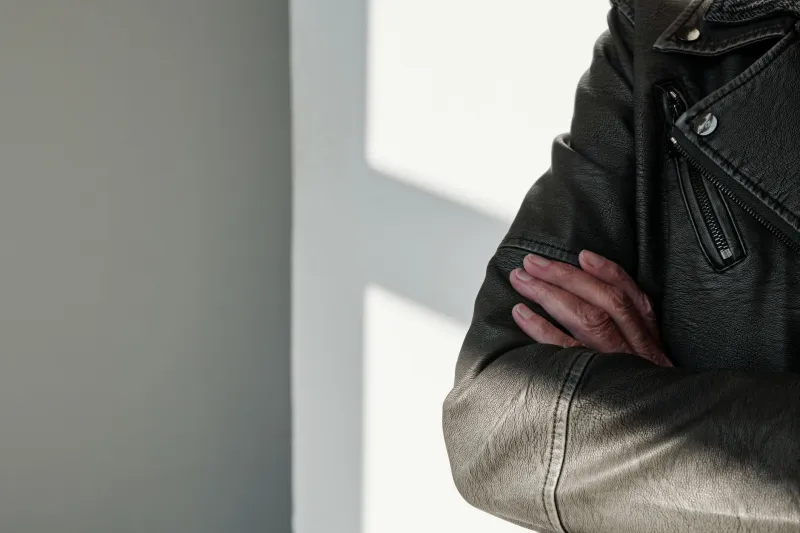
It looks like a gray hoodie. A plain white tee. Khakis that could belong to anyone. It looks like nothing at all.
And that's exactly the point.
The Strategy Nobody Photographs
When we talk about fashion as resistance, we almost always mean visibility — wearing your values loudly enough that the world has to reckon with them. None Of Us was built on that idea. But visibility is a privilege. For a lot of people in this country right now, being seen is the danger, not the solution.
Consider what it means to move through a city as an undocumented immigrant in a climate of aggressive enforcement. Or to attend a community organizing meeting in a neighborhood where you know you're being watched. Or to show up to a courthouse, a school board meeting, an ICE check-in, in clothing that could get you profiled before you've opened your mouth.
For these people, the uniform of choice isn't a statement piece. It's a disappearing act.
Maria, a community organizer working with undocumented families in the Southwest, describes it as a kind of daily costume. "I tell people, when you're going somewhere that feels risky, dress like you're going to a job interview at a bank," she says. "Not because you owe anyone that performance, but because boring clothes don't give anyone an excuse to look twice."
She calls it strategic camouflage. The goal isn't to erase identity — it's to protect the person wearing it long enough for them to get home safe.
Blending In as a Form of Protest
There's a long history here that fashion culture rarely acknowledges. During the civil rights movement, organizers were often coached on what to wear to marches and sit-ins — not for aesthetics, but for survival and optics. Neat, pressed clothing communicated dignity in the face of a system designed to deny it. It also made it harder for authorities to use appearance as a pretext for violence.
The same logic applied to early LGBTQ+ organizing, when being visibly queer in the wrong neighborhood could get you beaten or arrested. For many people, passing — dressing in a way that didn't flag their identity to hostile strangers — wasn't internalized shame. It was a calculated move that let them live to fight another day.
None of this is new. What's new is the scale and the stakes.
In 2025, with surveillance technology embedded in city infrastructure, with facial recognition being deployed by law enforcement at protests, with the political climate turning increasingly hostile toward immigrants, journalists, and organizers, the decision about what to wear carries weight that most people never have to think about.
"There are people at our meetings who dress to not be remembered," says Darius, an organizer with a tenant rights coalition in a major Midwestern city. "Nothing with logos. Nothing distinctive. The whole idea is that if someone is watching, they can't describe you afterward. You're just a person."
Just a person. In a world that wants to categorize and target, that anonymity is armor.
The Tension at the Heart of It
Here's where it gets complicated, and worth sitting with: there's a real tension between dressing for invisibility as survival and dressing for invisibility as erasure.
For some communities, the pressure to assimilate through clothing isn't a choice — it's a demand imposed from outside. The message that your traditional dress, your natural hair, your cultural markers make you a target is a form of violence in itself. The burden of camouflage falls unevenly. It lands hardest on the people who already carry the most.
So when we talk about strategic invisibility as a form of resistance, we have to be careful not to romanticize it or flatten it into a lifestyle aesthetic. This isn't a vibe. For the people doing it, it's a cost.
"I don't love it," Maria says plainly. "I have a whole wardrobe of things I love that I barely wear anymore. The invisibility is protective, but it's also a loss. It's something they took from me."
That framing matters. The choice to go gray isn't surrender. It's a tactical retreat made under duress, preserving energy and safety for the fights that actually count.
What the Blank Outfit Is Actually Saying
Here's the thing about a truly forgettable outfit: it only works because everyone around it is playing the same game. It borrows the camouflage of mainstream American blandness — the Gap-adjacent neutrals, the unremarkable sneakers, the total absence of anything that could be called a statement. It hides in the noise of the default.
And in doing that, it exposes something. The "neutral" aesthetic that makes invisibility possible is itself a product of a particular culture — white, middle-class, American-generic. The blank uniform works because it mimics the look of someone who has never had to think about being noticed. Someone who moves through the world assuming safety.
Wearing that uniform deliberately, as a shield, is a quiet act of subversion. It's using the dominant culture's own invisibility cloak against it.
"I think about it like going undercover," says Darius. "I'm not becoming someone else. I'm just borrowing their pass for a minute."
Resistance Has a Dress Code. It's Just Not the One You Think.
None Of Us has always believed that what you wear is political — not in some abstract, theoretical sense, but in the immediate, daily sense of who gets to move freely and who doesn't. We stand behind the bold graphics and the loud declarations. That's real resistance too.
But we also stand behind Maria in her plain jacket, heading into a meeting she shouldn't have to hide for. Behind Darius in his unmarked hoodie, making himself unrememberable because the alternative is dangerous. Behind everyone who has ever looked at their closet and made a calculated decision about what will keep them safest today.
The uniform of silence isn't glamorous. It doesn't photograph well. It won't trend.
But it's resistance. And it belongs in this conversation.
None of us gets to decide which form of survival is the most radical. Sometimes the most defiant thing a person can do is walk into a room and give no one anything to use against them. Sometimes blending in is the bravest outfit in the room.