We Dress as One: How Gen Z Traded Personal Style for Something Bigger
We Dress as One: How Gen Z Dressed Itself Into a Movement
There's a particular kind of confusion that hits when you scroll through certain corners of the internet and realize you can't tell where one person ends and the subculture begins. The boots are the same. The silhouettes rhyme. The color palette could've been agreed upon in a group chat — and honestly, it probably was. For a generation that was handed every conceivable tool for self-expression, Gen Z is doing something that looks, from the outside, a lot like giving those tools back.
They're dressing in formation. And they're doing it deliberately.
The Myth of the Individual Wardrobe
Let's be honest about something first: personal style has always been partially a lie. Every era of fashion that looked like radical self-expression was also a uniform. The hippies had their patchwork and their fringe. The punks had leather and safety pins. The '90s ravers had their candy-colored excess. What read as individual rebellion was, in every case, a group statement — a shared visual language that said we are not them louder than any single outfit could say I am me.
Gen Z didn't invent collective dressing. They just stopped pretending it was something else.
Where millennials were sold the gospel of personal branding — curate your feed, define your aesthetic, be the main character — younger people are increasingly skeptical of that framework. Maybe because they watched it get monetized into oblivion. Maybe because the algorithm turned every "unique" aesthetic into a trend cycle that lasted six weeks. Or maybe because when the world is on fire, standing out feels less important than standing together.
What the Uniform Actually Says
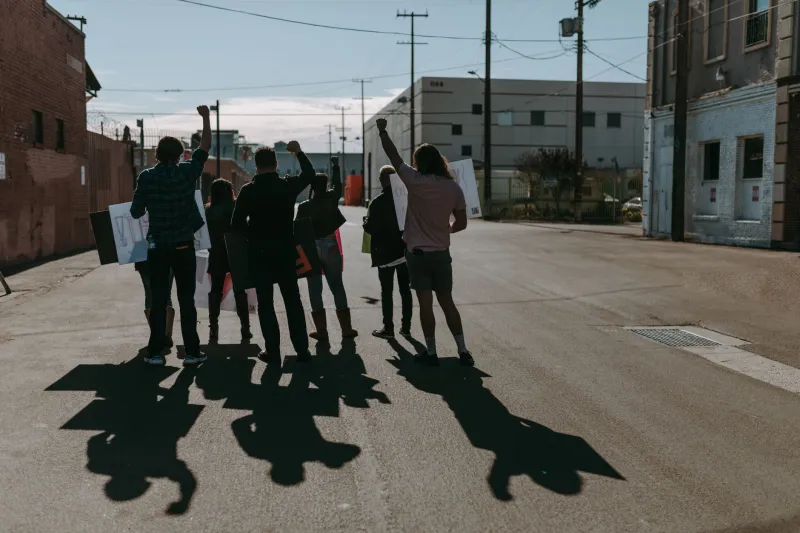
Walk into any organizing space, mutual aid hub, or protest crowd in a major US city right now and you'll notice something. There's a visual coherence that isn't accidental. The workwear. The earth tones. The functional layers. The boots built for walking. It's not a dress code anyone handed down — it emerged organically, the way subcultural aesthetics always do, through shared values expressing themselves through shared objects.
And then there's the other side of it: the online subcultures that have crystallized into something almost uniform in their uniformity. Gorpcore kids with their technical gear and trail runners. The old-money aesthetic crowd in their muted prep. The dark academia set in their wool coats and worn leather bags. Each of these looks functions less like a personal style choice and more like a membership card.
That's not an insult. Membership matters. Especially when you're twenty-two and the institutions that were supposed to give you a sense of belonging — college, organized religion, stable employment — have either priced you out or let you down.
Historical Echo Chamber
This pattern isn't new, and understanding where it comes from helps explain why it keeps coming back.
In postwar Britain, the Teddy Boys developed a look so specific it became a territorial marker. The mods and rockers weren't just musical factions — they were visual ones, and the clothes signaled allegiance before a single word was spoken. Across the Atlantic, the Black Panthers' uniform of black berets and leather jackets was a calculated visual strategy: it projected discipline, unity, and political seriousness at a moment when Black Americans were being systematically denied all three.
In each case, the uniform did double duty. It created internal cohesion — we recognize each other — and communicated something to the outside world. It transformed a group of individuals into a legible force.
Gen Z is doing the same thing, just with more irony and better access to vintage.
The Absorption Problem
Here's where it gets complicated, because it always gets complicated.
The moment a subcultural uniform becomes visible enough to mean something, it becomes visible enough to sell. We've watched it happen in real time. Workwear aesthetics got picked up by fast fashion brands selling "labor-core" without any relationship to actual labor. Protest imagery ended up on Target tees within months of the movements that generated it. The visual language of mutual aid got aestheticized into content.
This is the trap. When collective identity becomes a trend, it loses the thing that made it collective in the first place — the shared stakes. You can buy the look without buying into what the look was built to express. And once enough people are wearing it without knowing why, the signal gets noise-flooded.
The question Gen Z is actively wrestling with — sometimes consciously, sometimes just through the choices they make when they get dressed — is how to maintain a visual identity that means something when the machinery of capitalism is specifically designed to extract that meaning and resell it back to you.
Wearing the Group Without Losing Yourself
What's genuinely interesting about the current moment is that the most thoughtful version of this collective dressing isn't actually anti-individual. It's more like a negotiation.
You see it in the way people within a subculture will share a silhouette but personalize a detail. The way a patch or a pin or a specific worn-in quality signals not just I belong here but I've been here a while. The way thrift and trade and hand-me-downs circulate within communities so that the clothes carry actual relational history, not just aesthetic alignment.
That's the version worth paying attention to. Not the algorithm-generated micro-trend that looks like collective identity but is really just synchronized consumption. The real thing is slower, more local, and harder to photograph for a brand campaign.
None of Us, All at Once
The name of this site isn't accidental. None of us — as in, not one of us alone — is the point. The individual as the primary unit of meaning has been a useful fiction for selling things, but it's a rough foundation for building anything that lasts.
When young people choose to dress like their people, they're not giving up on themselves. They're making a different kind of claim: that who they are is inseparable from who they're with. That identity isn't something you perform in isolation. That a shared visual language is a form of care, a way of saying I see you before a single word gets spoken.
The uniform, at its best, isn't a cage. It's a signal fire.
The trick — and it's always a trick worth working at — is making sure the fire stays yours. That the clothes you choose to share with your community came from somewhere real, point toward something real, and can't be flattened into a campaign by a brand that wants the aesthetic without the politics.
Wear it like you mean it. Or don't wear it at all.