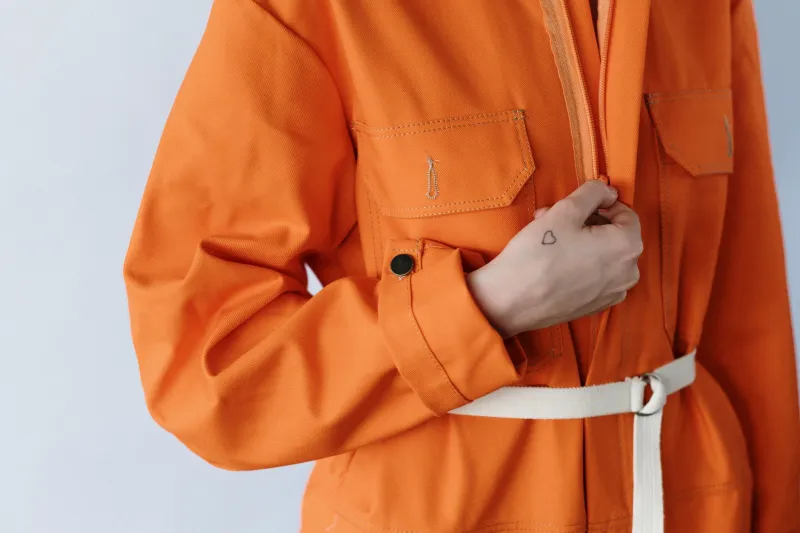
Button It Up: The Return of the Dress Code and the People Refusing to Comply

Somewhere around 2020, millions of Americans quietly stopped dressing for anyone but themselves. Sweatpants became a lifestyle. The blazer gathered dust. And for a brief, disorienting moment, it felt like the whole performance of workplace appearance might finally be over.
It wasn't.
If anything, the pendulum has swung harder in the opposite direction. Across industries — finance, hospitality, retail, healthcare, education — employers and institutions are doubling down on appearance standards with a specificity that feels almost personal. We're not talking vague "dress professionally" language anymore. We're talking documented policies: no visible tattoos, no unnatural hair colors, no open-toed shoes, no hoodies under any circumstances, collar required, logo tees prohibited. The leash is back, and it's been shortened.
The question is: what are you going to do about it?
Why Now? The Politics of Post-Pandemic Control
Let's be honest about what's actually happening here. The return-to-office push isn't just about productivity metrics or collaboration culture. It's about reasserting a particular kind of order — one that was visibly slipping when everyone was working from a kitchen table in whatever they wanted. Dress codes are part of that reassertion. They're a signal. We run this place. You work here. Dress like it.
Institutions have always used appearance as a proxy for compliance. Schools figured this out decades ago. The military built an entire identity around it. Corporate America followed the same logic: if we can get people to look a certain way, we've already won half the battle of getting them to behave a certain way. The uniform isn't just about aesthetics. It's about psychological alignment. It's about making sure you feel, every single morning when you get dressed, that your body belongs to someone else's project.
What's new right now is the granularity. HR departments are issuing updates that read less like workplace guidelines and more like terms of service for your own body. And they're enforcing them — write-ups, sent-home incidents, terminations. The stakes are real.
Who's Actually Getting Hit
The enforcement isn't landing evenly, and that's worth saying clearly.
Black employees are disproportionately flagged for natural hair styles, even in states that technically have CROWN Act protections on the books. Women in male-dominated industries face appearance scrutiny that their male colleagues simply don't. Employees with visible disability accommodations — adaptive footwear, medical devices, modified clothing — find themselves navigating dress code policies that weren't written with them in mind and don't particularly care to adjust. Younger workers, especially Gen Z employees who came up in an era of genuine style fluidity, are colliding hard with legacy policies written by people who think business casual is a moral stance.
The dress code isn't neutral. It never was. It encodes a specific vision of who belongs in a given space and what that person looks like. Enforcing it is, at its core, an act of power.
The Resisters
And yet. People are pushing back, and they're doing it with more strategic intelligence than a simple act of defiance would suggest.
Take the approach of what you might call technical compliance — following the letter of the policy while gutting its spirit entirely. Dress codes that require "collared shirts" get met with vintage bowling shirts in colors no manager expected. "Business casual" becomes an opportunity to surface a perfectly pressed pair of wide-leg trousers in a pattern so loud it constitutes its own statement. The rule says nothing about that. The rule never anticipated that.
There's also the slow accumulation strategy — introducing one small deviation at a time, making each individual choice deniable, until your overall look has drifted so far from what was intended that the original policy barely applies anymore. A pin here. A different cut there. Shoes that technically meet the standard but carry a very specific energy. None of it is a fireable offense. All of it is deliberate.
For employees in environments where visible body art is prohibited, the workaround has become the art form. Placement matters. Long sleeves become a canvas that reveals itself after hours. Jewelry carries meaning that a dress code policy isn't equipped to read. The uniform gets worn, and underneath it, the person wearing it remains entirely intact.
What You're Actually Protecting
Here's the thing about dress codes that the people enforcing them don't want you to think too hard about: the goal isn't a neat, professional appearance. The goal is the process of achieving it. The goal is getting you to spend your morning negotiating your own identity against someone else's checklist. The goal is making you smaller before you even walk through the door.
When you push back — even in small, deniable ways — you're not just making a fashion choice. You're refusing to let the morning ritual be an act of self-erasure. You're insisting that the person who shows up to work is still, actually, you.
That's not nothing. In fact, it might be everything.
Practical Moves for Pushing Back Without Getting Fired
None of this is worth your livelihood if you're not strategic about it. A few principles that the most effective dress code resisters tend to follow:
Read the policy like a lawyer. Most dress codes are sloppily written. Find the gaps. "Professional attire" is not a definition. "Neat and clean" is not a definition. The vaguer the language, the more room you have.
Document everything. If you're being singled out for enforcement that isn't being applied to your colleagues, that's worth noting. Dates, times, what was said. This is especially important if you suspect the enforcement is tracking along racial, gender, or disability lines.
Build allies. You are almost certainly not the only person in your workplace who finds the dress code infantilizing. Finding each other matters, both for morale and for collective action.
Know your actual rights. The CROWN Act, ADA accommodations, Title VII protections — these are real tools. They're imperfect and inconsistently enforced, but they exist. Know what applies to your state and your situation.
Make your choices intentional. Random sloppiness is just sloppiness. Deliberate, thoughtful deviation is resistance. The difference is whether you know why you're doing what you're doing.
The Bigger Picture
Dress codes are making a comeback because control is making a comeback. The two have always traveled together. Every time an institution feels its authority slipping, it reaches for the most visible lever it has — the one that shows up on your body every single day.
The people refusing to comply aren't just being difficult. They're doing what resistant people have always done: insisting on the right to exist in their own skin, on their own terms, inside systems that would prefer they didn't. The stakes feel small — a shirt, a hair color, a pair of shoes. But the principle underneath them is not small at all.
None of us got here by following someone else's dress code. And none of us are about to start now.