Locked In, Dressed Out: The Radical Politics of Wearing What They Made You Wear
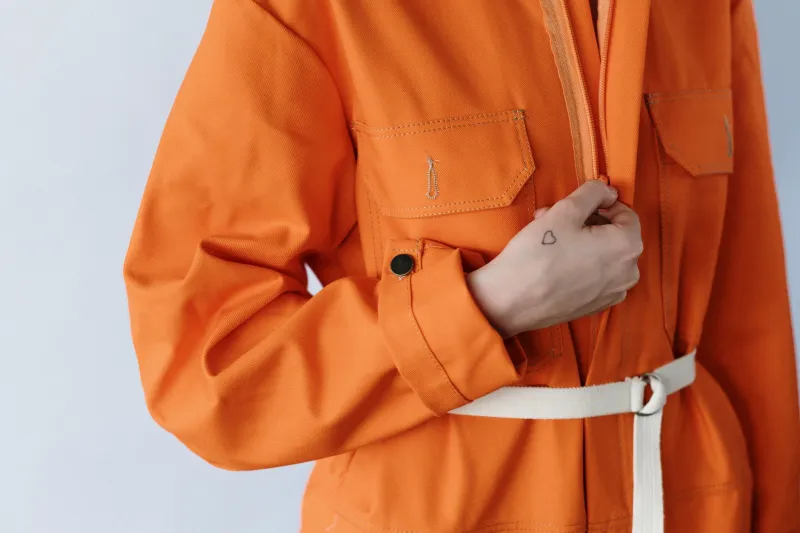
There's a specific shade of orange that doesn't belong on a runway. You know the one. It's not burnt sienna or rust or the warm amber of a vintage Carhartt. It's the flat, institutional, zero-ambiguity orange of a county jail jumpsuit — the kind designed to make you visible, trackable, and stripped of any identity that isn't inmate. So when that color started showing up on streetwear drops, on independent designers' lookbooks, on the backs of people who've done time or lost someone to the system — the conversation that followed wasn't about aesthetics. It was about ownership.
This is the friction at the center of what some are calling prison-core, carceral fashion, or — more pointedly — reclamation dressing. And it's a lot more complicated than whatever think-piece the mainstream fashion press churned out when the trend hit their radar.
The Uniform Was Never Just a Uniform
Clothing has always been a tool of control. Prisons, detention centers, and carceral institutions understood this long before streetwear did. Standardized dress isn't just logistical — it's psychological. Strip someone of their clothes, hand them a uniform, and you've started the process of erasing the person underneath. The orange jumpsuit, the grey sweats, the paper-thin slip-ons — these aren't neutral garments. They're instruments.
Which is exactly why reclaiming them hits different.
When someone who has worn that uniform by force chooses to wear something that references it — on their own terms, in their own context, with their own meaning layered on top — that's not fashion. That's defiance. It's the same impulse behind prison tattoos becoming high art, behind the way formerly incarcerated people have always found ways to mark themselves as survivors of rather than defined by. The symbol gets flipped. The institution loses its monopoly on the meaning.
Who's Actually Doing the Work
The designers operating in this space aren't doing it for shock value. At least, the ones worth paying attention to aren't.
Take the small-batch labels coming out of communities in cities like Atlanta, Chicago, and LA — places where the carceral system isn't an abstract political talking point but a lived, generational reality. These designers are making jumpsuits in that specific orange, but they're cutting them differently. They're adding structure, embroidery, hand-stitched text. They're printing the names of people killed in custody onto the back panels. They're turning detention-grey hoodies into canvases for Black liberation iconography. The garment becomes an argument.
The message isn't look how edgy I am. The message is you tried to make this mean powerlessness, and we're making it mean something else entirely. That's a fundamentally different creative act than a luxury brand slapping handcuff hardware on a $900 bag because it tested well with their 18-34 demographic.
The Appropriation Problem Doesn't Go Away
Here's where it gets uncomfortable, and we're not going to pretend otherwise.
Reclamation only works when it's done by the people who were harmed by the original symbol. The moment carceral aesthetics migrate from that context into the broader fashion market — into fast fashion, into luxury, into the closets of people who've never had a family member sit in a holding cell — something gets lost. The symbol gets laundered. It stops being a confrontation with the system and starts being a costume.
And the US fashion industry has a long, ugly history of doing exactly this. Extracting the visual language of marginalized communities, filing off the political edges, and selling it back to a consumer base that doesn't carry the weight of what that imagery actually means. We've seen it with hip-hop aesthetics, with Native American-inspired prints, with the commodification of protest imagery after every major civil rights moment. Prison-core is not immune to that machine.
The question isn't whether the aesthetic can be reclaimed. It's who's reclaiming it, and who's profiting.
Wearing It vs. Performing It
There's a version of this conversation that gets reductive fast — the idea that only people who've been incarcerated can engage with carceral aesthetics at all. That's not quite right either. Solidarity dressing is real. Wearing something that signals I see this system, I oppose this system, I'm not pretending it doesn't exist is a legitimate act, as long as you're honest about what you're doing and who you're centering.
The difference is between wearing something as a statement and wearing something as a prop. Between buying from a designer who's building something meaningful out of their own experience and buying a knockoff of that energy from a brand that saw an opportunity.
It comes back to the same questions we always end up asking here: Who made it? What does it cost them? What does it cost you? What does it say, and to whom?
The System Doesn't Get to Own the Symbols Forever
The United States incarcerates more people than any other country on earth. That's not a footnote — it's the context for everything happening in this conversation. The carceral system is not some fringe institution. It touches millions of families, disproportionately Black, brown, and poor, and it uses every tool available — including the visual language of dehumanization — to maintain its grip.
When designers and communities push back through clothing, they're doing something the system didn't anticipate: they're making the uniform speak. They're refusing to let the institution be the only author of what those garments mean.
That's worth paying attention to. It's worth supporting, when the people doing it are the right people. And it's worth being skeptical of, when the people doing it are just trying to move product.
Fashion has always been political. The clothes that were meant to strip identity have a way of becoming the clothes that restore it — but only when the people wearing them know exactly what they're doing and why. The rest of us owe it to that history to pay attention before we reach for the hanger.