Dressed for Nobody: How Your Everyday Wardrobe Is Already a Political Act
There's a version of resistance that makes the news. It shows up in photographs — crowds, fists, hand-lettered cardboard. It's loud and necessary and real. But there's another version that happens at 7:15 on a Tuesday morning, in a bathroom mirror, before anyone else is even awake. It doesn't trend. It doesn't get covered. And it might be doing more sustained work than any single weekend march ever could.
What you wear every single day — to the office, to your parents' house, to the town where you grew up and couldn't wait to leave — is a form of communication that runs underneath language. It operates in spaces where saying the quiet part out loud would cost you something: a job, a relationship, a seat at a table you still need access to. And for a lot of people, it's the only form of self-expression they can afford to have on full display.
The Office as a Controlled Environment
Corporate dress codes are rarely written to suppress identity. They're written to standardize it, which is arguably worse. When a policy says "business casual" or "professional attire," what it usually means is: make yourself legible to the people in charge. Dress like someone who isn't going to be a problem.
So what do you do when you are, in fact, going to be a problem — or at least, when you have no interest in performing the kind of neutrality the institution is asking for?
Some people go subtle. A binder worn under a button-down. Nail polish in a color that sits just inside the line of plausible deniability. A pronoun pin tucked onto a lanyard where HR would have to squint to read it. These aren't compromises. They're negotiations — daily decisions about which battles are worth fighting openly and which ones are better fought quietly, over time, by simply being there and refusing to disappear entirely.
Others go structural. Deliberately androgynous silhouettes that comply with the letter of a dress code while refusing its spirit. Vintage workwear that reads as "professional" to a manager and as a specific kind of working-class solidarity to anyone who knows what they're looking at. The clothes technically check the boxes. The intent is something else entirely.
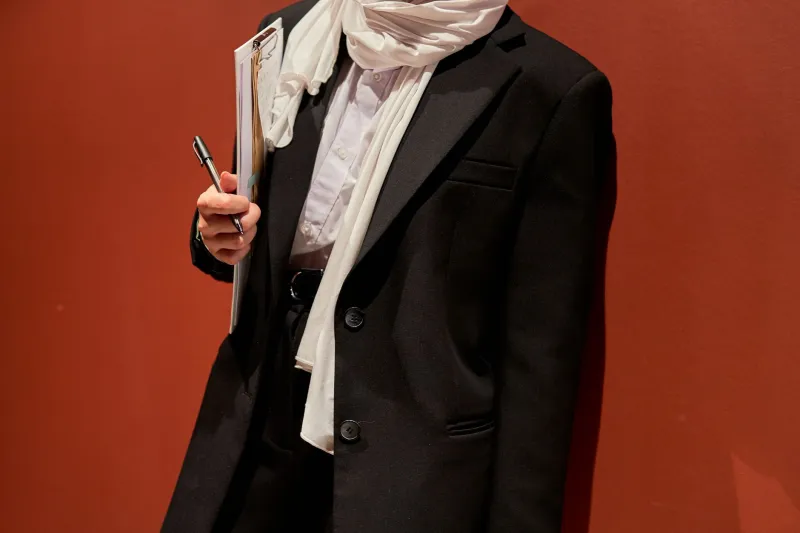
"I wear the same neutral blazer to every client meeting," says one graphic designer in Chicago who asked to stay anonymous. "It's boring on purpose. But underneath it I'm wearing a shirt I screenprinted myself with a design that would get me fired if anyone saw it. That's mine. They don't get that part."
Family Gatherings and the Art of Strategic Visibility
The workplace has rules you can at least read. Family is harder. The dress code at Thanksgiving isn't written down anywhere, but everyone in the room knows exactly what it is.
For people navigating conservative family spaces — especially queer people, people of color code-switching across cultural contexts, or anyone who's grown away from the community they came from — getting dressed for a holiday visit is an act of constant calibration. How much of yourself do you bring into this room? What are you willing to defend? What's not worth the argument this year?
Some people cover their tattoos for family dinners — not because they're ashamed of them, but because they've learned to protect their energy. Others do the opposite: they show up exactly as they are, every time, not as a confrontation but as a slow, patient insistence on being seen. Neither approach is more valid. Both are strategic. Both are resistance.
What matters is that the choice is yours. The moment you're dressing to manage someone else's comfort rather than your own survival, something shifts. There's a difference between choosing to wear long sleeves because you don't have the bandwidth for that conversation today, and wearing them because you've internalized the idea that your body needs to be hidden. One is tactical. The other is something you might want to examine.
Visibility as a Long Game
Here's what the protest-sign model of resistance gets right: collective visibility matters. When enough people show up in the same space looking like themselves, it changes what that space looks like. It changes what's considered normal. It changes who feels like they can walk in the door.
But that shift doesn't happen only at rallies. It happens in break rooms and boardrooms and family living rooms, over years and decades, because someone kept showing up and kept refusing to fully disappear. The person who wore their natural hair to work in 2003 before it was protected by law in most states. The trans man who wore a suit to his conservative employer's holiday party in 2011 and didn't explain himself to anyone. The woman who stopped wearing heels to client presentations in 2018 and watched two younger colleagues quietly do the same thing the following month.
None of those moments made the news. All of them moved something.
What "None of Us" Actually Means
The name of this brand isn't accidental. None of us — as in, none of us exist in isolation. What you wear ripples outward. The choices you make about how to present yourself, even in spaces that are trying to flatten you, accumulate into something. Your wardrobe isn't just personal expression. It's data. It's proof of existence. It's a slow, persistent argument that you're making with your body every single day, whether you intend to or not.
So you might as well be intentional about it.
You don't have to wear a slogan. You don't have to explain yourself. You don't have to dress for anyone else's politics or anyone else's comfort. But it's worth knowing that the clothes you put on before you walk out the door are already saying something. The only question is whether you're the one deciding what they say.
Wear what keeps you safe. Wear what keeps you sane. And when you have the room to wear something that's actually, fully, unapologetically yours — take it.