What You Wear When No One's Watching: The Honest Wardrobe
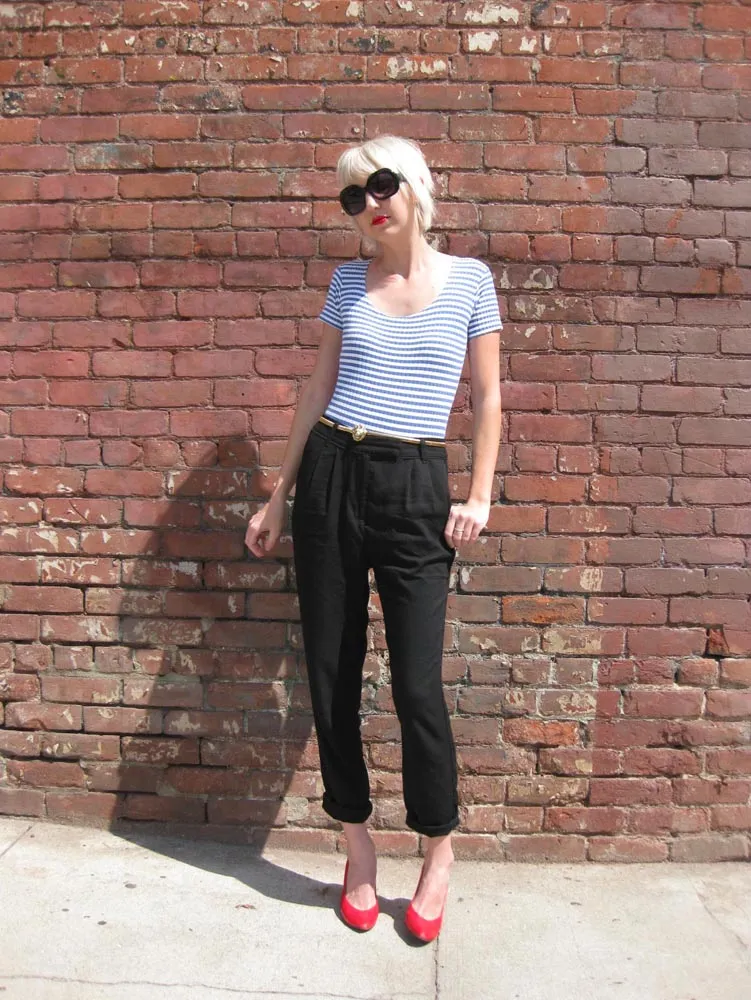
Photo: CastawayVintage, CC BY 2.0, via Wikimedia Commons
There's a t-shirt in your drawer right now that you would never post. You know the one. The neck is stretched out. There's a stain near the hem that survived three washes and just became part of the fabric's history. The graphic — if there ever was one — has faded into a ghost of itself, a suggestion of something that used to have a point. You've had it for years. Maybe a decade. You wear it constantly, just never anywhere that counts.
Except it counts the most.
The Clothes That Don't Perform
We've built an entire cultural infrastructure around the idea that what you wear is a message — a signal to the world, a brand, a carefully assembled projection of self. And look, that's real. Fashion has always been communication. But somewhere along the way, the signal got louder than the actual person sending it, and a lot of us started dressing for an imagined audience even when we were sitting alone in our own apartments at 11pm eating cereal.
The basics you wear in private don't have that problem. They opted out of the performance a long time ago — or more accurately, you let them. Nobody's grading your faded gray sweatpants. No algorithm is boosting your beat-up Hanes. The worn-out flannel you throw on every Saturday morning doesn't care about your personal brand. It just keeps you warm.
And in that total absence of performance, something honest slips through.
What the Ratty Stuff Actually Reveals
Pay attention to your private uniform for a second. Not the stuff you'd wear to a show or a protest or a first date — the stuff you wear when you're doing dishes, watching something dumb on your laptop, or just existing in your own space. What does it look like?
Most people, if they're honest, have a pretty consistent private aesthetic. The same three or four pieces that rotate endlessly. And those pieces tend to cluster around something real: a band that actually mattered to you before they blew up, a college you have complicated feelings about, a gift from someone you loved, a shirt you bought at a gas station on a road trip that somehow became sacred. These clothes carry weight that has nothing to do with how they look.
That's the thing about the honest wardrobe — it's less about style and more about sediment. It's what's left when you strip away the curation. What you keep wearing when there's no reason to keep wearing it except that it feels like yours.
The Tyranny of the Imagined Audience
Social media didn't invent self-consciousness about clothing, but it definitely industrialized it. There's a whole genre of content built around the idea that every outfit is a set, every mirror is a stage. "What I wore this week" as a format implies that what you wore is always worth documenting, always worth presenting. And if everything is content, then the ratty stuff — the real stuff — either gets hidden or it becomes a bit. The performative sloppiness, the ironic "I woke up like this" post that took forty-five minutes to set up.
The imagined audience is brutal. It doesn't sleep. And the worst part is that it doesn't even need to be real — you can be completely alone and still dress for it, still feel the low-level anxiety of wearing something that doesn't hold up to scrutiny. That's how deep it goes.
Which is why the clothes that have escaped that gravity feel so different. There's a specific kind of relief in pulling on something that you know, without question, you would never photograph. It's not defeat. It's permission.
Liberation in the Low-Stakes
Here's an argument worth sitting with: the most free you ever are in your clothes is when nobody — including you — is evaluating them.
That faded hoodie with the broken drawstring? You're not performing comfort in that thing. You're just comfortable. The jeans with the blown-out knee that you've been meaning to patch for two years? You're not doing a look. You're just wearing pants. There's no gap between the intention and the reality, no distance between who you're trying to seem like and who you actually are at 7am on a Sunday.
That gap — the space between the projected self and the private self — is where a lot of fashion anxiety lives. And the basics you wear alone are the proof that the gap can close. That you can just be a person in clothes without the clothes needing to mean anything beyond keeping you decent.
The Case for Treating Your Private Wardrobe Like It Matters
None of this is an argument for giving up on how you dress in public. Clothes as expression, clothes as resistance, clothes as communication — all of that is real and worth doing with intention. But there's something worth protecting in the private wardrobe. Something worth noticing.
If the honest stuff is always hidden — if the real you only comes out in clothes you'd be embarrassed to admit you love — that's worth examining. Not to fix it, necessarily, but to understand what it's telling you. Maybe your public wardrobe is genuinely expressive and your private wardrobe is just functional. Or maybe the private wardrobe is the more honest one and everything else is armor.
Some people, when they really look at what they reach for when nobody's watching, find that it tells them something useful about what they actually value versus what they've been performing. The vintage tee that's too destroyed to wear out but too meaningful to throw away. The oversized flannel that belonged to someone else first. The band shirt from a show that changed something in you, worn soft and thin from years of use.
That stuff is a record. An archive of the self that doesn't get edited for the feed.
What None of Us Actually Looks Like
There's a reason the brand is called None Of Us. Not some of us. Not the best-dressed among us. All of us, together, in our most unfiltered version — the version that exists before the audience arrives.
The honest wardrobe is where that version lives. It's not polished. It's not aspirational. It's not optimized for anything. It's just real in a way that most of what we put on for the world never quite manages to be.
Wear the ratty shirt. Know what it means to you. That's enough.