Somebody Lived in These Clothes: The Hidden Archives Hanging on Thrift Store Racks
Photo: Unknown authorUnknown author, CC0, via Wikimedia Commons
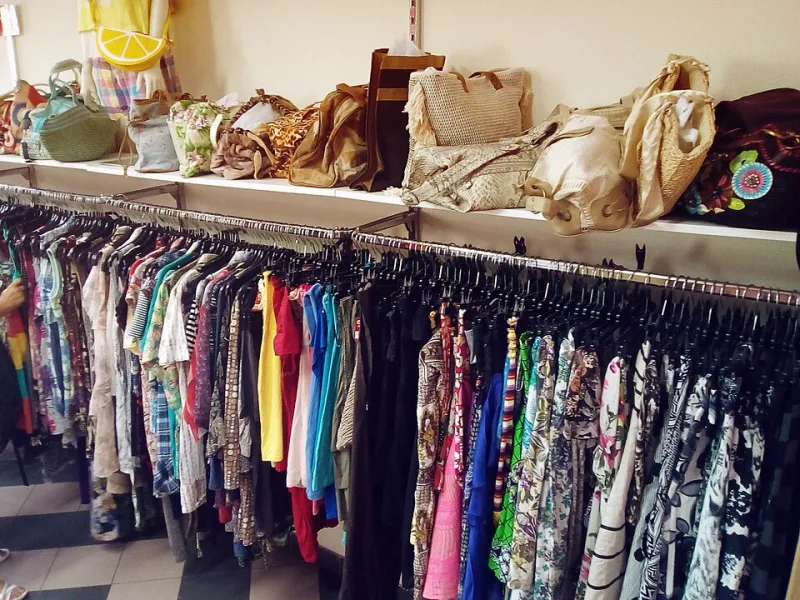
There's a particular kind of silence in a thrift store. Not the silence of emptiness — the silence of accumulation. Thousands of garments, each one surrendered by someone, for some reason, at some point. A Goodwill in East LA doesn't curate its inventory the way a museum curates its collection, but maybe it should. Because what's hanging on those circular racks, jammed between a Gap denim jacket and a sequined prom dress from 2003, is often something that belongs in a glass case — or at the very least, deserves more than a $3.99 tag.
This isn't a nostalgia piece. It's a reckoning.
What Gets Donated Is Never Random
People donate for all kinds of reasons. Downsizing. Death. Moving across the country. Leaving a life behind. And when the person doing the donating comes from a community that's been systematically pushed to the margins — queer elders, immigrant families, subcultural survivors — what ends up on that rack is sometimes the material record of an entire way of living that mainstream history refuses to document properly.
Think about what happens to a queer man's wardrobe when he dies and his family, estranged or simply unaware, clears out his apartment. Or the suitcase of clothing a Salvadoran grandmother brought north in the '80s, finally passed on when she passes on. Or the leather jacket from a punk kid who grew up, moved to the suburbs, and quietly folded that version of themselves into a box.
Those clothes end up somewhere. Usually a bin. Usually a rack. Usually priced at whatever the volunteer with the sticker gun decides they're worth.
They are worth more than that. They always have been.
Queer Dress as Survival Document
Queer fashion has never been just fashion. It's been code, community signal, and sometimes the only way to find your people in a world that wanted you invisible. The handkerchief codes of the '70s. The specific cut of a dyke's flannel in the '90s. The oversized tees worn at ACT UP marches, silk-screened in someone's garage because no brand was going to do it for them.
These garments circulate through thrift stores constantly — especially in cities like San Francisco, New York, Chicago, and LA, where queer communities have lived in concentrated, vibrant, and brutally decimated waves. The AIDS crisis alone emptied out entire wardrobes into the donation stream. What does it mean to pick up a vintage Silence = Death tee at a thrift store in the Castro and not know what you're holding?
It means the archive is leaking. It means the memory is going somewhere it might not be recognized.
This isn't an argument against buying those pieces. It's an argument for buying them knowing. For doing the work of understanding what you've got before you make it part of your aesthetic.
Immigration and the Wardrobe as Passage
Clothing carried across borders carries more than fabric. It carries the logic of a different place — different proportions, different construction, different color relationships. Garments from immigrant communities that end up in American thrift stores are often pieces that didn't survive the assimilation pressure, things that felt too visible, too foreign, too much like the old country in a context that punished that.
The Mexican-American communities of the Southwest, Vietnamese families in the Gulf Coast, Haitian households in South Florida — their donated clothing tells the story of negotiation. What got kept. What got let go. What got worn only at home, then eventually surrendered to a bin because the generation that understood it was gone.
When you pull a hand-embroidered blouse or a tailored guayabera off a rack in a predominantly Latino neighborhood and bring it home as a "find," you are in possession of something that was never meant for you. That doesn't make you a bad person. It makes you responsible. There's a difference.
Subcultural Sediment
Beyond queer history and immigration, thrift stores are where subcultures go when they die — or evolve past recognition. Punk. Goth. Riot Grrrl. Hardcore. Rave. Rockabilly. Each of these scenes produced garments that weren't manufactured so much as made — modified, safety-pinned, painted, patched into existence by people who were building identity in real time with whatever they could get their hands on.
A hand-painted denim vest from a mid-'90s hardcore show isn't just vintage. It's a primary source. It's somebody's politics, their social world, their whole sense of self expressed in thread and spray paint. The band names on the back are a bibliography. The patches are a manifesto.
These pieces don't come with provenance. They come with a price tag. And then they go home with whoever found them first.
The Ethics of Touching Someone Else's Resistance
So what's the responsible move here? A few thoughts, none of them simple:
Learn before you wear. If you pick up something that has obvious subcultural or community significance — a piece with political imagery, ethnic craft traditions, or visible movement iconography — do the reading. Know what you've got. Don't reduce it to vibes.
Keep the chain going. If you buy something with a history you can trace, document it. Even a social media post that explains the context is better than silence. The archive doesn't have to stop with you.
Consider who's shopping with you. Gentrification operates in thrift stores too. When wealthier shoppers flood into neighborhood thrift stores and price out the communities those stores were built to serve, the cultural artifacts in those stores leave the community permanently. That's a real harm. Be aware of where you're shopping and what your presence does to the ecosystem.
Don't aestheticize struggle without acknowledging it. There's a version of thrift culture that treats every difficult history as a cool backstory. That version is extractive. Wearing someone's resistance without understanding it is just another form of consumption — a little slower, a little cheaper, but still fundamentally about what you get out of it.
What the Rack Is Actually Asking
The clothes on a thrift store rack aren't asking to be saved. They're not waiting for the right buyer to give them meaning. They already have meaning. They arrived with it.
What they're asking — if we're being honest about what it means to participate in this economy — is whether you're capable of receiving that meaning. Whether you can hold a garment that came from a life you don't share and treat it with the weight it deserves. Whether you can wear someone else's history without flattening it into your own story.
None of us exist outside of history. The clothes we wear don't either. The thrift store is the place where that truth is hardest to ignore — where the evidence piles up, rack after rack, that people lived in these things. People who weren't you. People who, in many cases, had everything working against them.
Wear that with some awareness. It's the least the archive deserves.