Follow the Money: What Happens to Your Fast Fashion Dollar After You Swipe
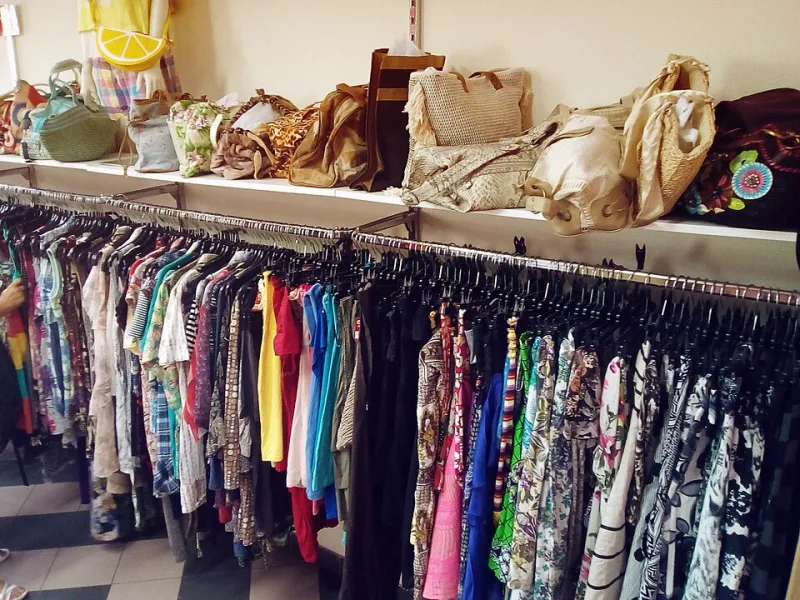
Photo: MAKY.OREL, CC BY-SA 4.0, via Wikimedia Commons
Let's skip the part where we congratulate ourselves.
You already know thrifting is better than buying new. You've seen the infographics. You've watched the documentaries. You know about the Atacama Desert in Chile, where an estimated 39,000 tons of discarded clothing pile up annually in a synthetic mountain range of failed trend cycles and sub-minimum-wage labor. You know about the Kantamanto Market in Accra, Ghana — one of the largest secondhand clothing markets in the world — drowning in the overflow of Western overconsumption, where roughly 40 percent of the 15 million garments arriving weekly ends up as waste. You know.
So this isn't a guilt trip. This is a different kind of conversation — one about mechanics. About where money actually flows, what it funds, and why spending five dollars at a Goodwill outlet is a materially different act than spending thirty-five dollars at a Shein haul.
The Supply Chain Is a Financing Mechanism
Fast fashion doesn't just produce clothing. It produces demand infrastructure. Every purchase signals to a brand's buyers, logistics teams, and production partners that the pipeline should keep moving. The business model depends on velocity — not just selling fast, but manufacturing the psychological conditions that make you want to buy again in three weeks.
Here's something the industry doesn't advertise: overproduction isn't a bug in fast fashion's system. It's a feature. Brands routinely manufacture 30 to 40 percent more inventory than they expect to sell, because running out of stock costs more — in lost sales and brand perception — than eating the surplus. That surplus has to go somewhere. Some of it gets marked down. Some gets exported. Some gets incinerated. In 2018, Burberry made headlines for destroying $37 million worth of unsold goods rather than discount them. That's a luxury brand protecting its price integrity by lighting product on fire. The logic scales down the market.
When you buy from these brands — even on sale, even secondhand from their own outlets — you're still participating in the feedback loop that justifies the next production run.
Dead Stock Is a Different Animal
The term "dead stock" gets used loosely, but in its truest form it means inventory that has permanently exited the commercial pipeline — goods that will never generate revenue for their original manufacturer. Vintage pieces from defunct labels. Surplus fabric runs from factories that have since closed. NOS (new old stock) items sitting in a warehouse for a decade before hitting a thrift rack.
When you buy dead stock, you're not just making a sustainable choice. You're consuming something that generates zero new production signal. There is no algorithm watching that transaction and telling a factory in Bangladesh to start another run of the same silhouette. The economic chain stops.
Regular thrift shopping operates on a similar principle, with some nuance. Purchasing a five-year-old H&M jacket at Goodwill doesn't send money to H&M. It sends money to Goodwill, which — whatever your feelings about their wage practices — is at minimum not funding new exploitation. The original brand received its revenue years ago, and no signal travels back upstream to justify new production.
Aggregate Behavior Is the Only Lever Individuals Have
Here's where people usually check out of this conversation, because it bumps into the uncomfortable reality that individual consumer choices, in isolation, don't move markets. And that's true. One person permanently switching to secondhand doesn't register as a data point in a quarterly earnings call at Zara.
But behavior aggregates. And the numbers suggest that the aggregation is already happening in ways that are genuinely making fast fashion nervous.
The US secondhand apparel market was valued at approximately $43 billion in 2023 and is projected to reach $73 billion by 2028, according to ThredUp's annual resale report. Meanwhile, traditional retail has been contracting. Some of that growth is the platforms — ThredUp, Poshmark, Depop, The RealReal — cannibalizing the new goods market directly. Brands have noticed. Why else would H&M, Levi's, and Patagonia all launch their own resale programs? They're not doing it out of environmental conscience. They're doing it because secondhand is eating their lunch and they'd rather own a piece of the cannibalization than watch it happen from the outside.
That's not feel-good sustainability theater. That's market pressure made visible.
The Class Politics of Secondhand (Because We Have to Go Here)
Any honest take on thrift-as-resistance has to sit with the class dynamics involved. Thrift stores have historically been where people with no other options shop. The gentrification of secondhand — the vintage resellers flipping Levi's 501s for $120, the Depop aesthetic making thrift hauls a content genre — has materially raised prices at Goodwill and Salvation Army locations in urban areas, pricing out the communities who depend on them.
This doesn't cancel the economic argument for secondhand. But it complicates the self-congratulation. Buying secondhand as a political statement is a position of privilege — you're choosing to opt out of new consumption, which means you had the option to opt in. That's worth holding alongside the broader argument.
The goal isn't to perform virtue through your purchasing habits. The goal is to actually withdraw capital from systems that are built on exploitation, and to do it consistently enough that it shows up in someone's spreadsheet somewhere.
What Withdrawal Actually Looks Like
Practically speaking, a genuine capital withdrawal from fast fashion looks something like this: you stop buying new from brands whose business model requires disposability. Not just the obvious offenders — not just Shein and Temu — but the mid-tier players whose sustainability marketing is doing a lot of heavy lifting over a production model that hasn't fundamentally changed.
You source secondhand first. Not as a last resort, not as a budget move you'll graduate out of when you make more money — as a default. You buy dead stock when you can find it. You learn to repair things. You wear the same stuff for longer than trend cycles want you to.
None of this is revolutionary in isolation. Collectively, it's a slow bleed on an industry that has spent fifty years engineering the idea that wearing something twice is embarrassing.
The Point Isn't Purity
You're going to buy new things sometimes. So is everyone. The point isn't to achieve some pristine consumer record that you can cite in arguments on the internet. The point is to understand what your money does when you spend it — who it reaches, what behavior it reinforces, what pipeline it keeps funded.
Fast fashion's power is that it made spending feel consequence-free. Frictionless checkout, dopamine-optimized product photography, next-day delivery, return policies designed to reduce purchase hesitation. The entire apparatus exists to make you forget that a transaction is a transfer of value with real-world effects.
The thrift store isn't glamorous. The dead stock rack takes time to dig through. The secondhand market requires patience that the fast fashion industry specifically engineered you not to have.
That friction is the point. It's where the resistance lives.