Take It Apart: Why Altering Your Own Clothes Is the One Move Fashion Can't Sell Back to You
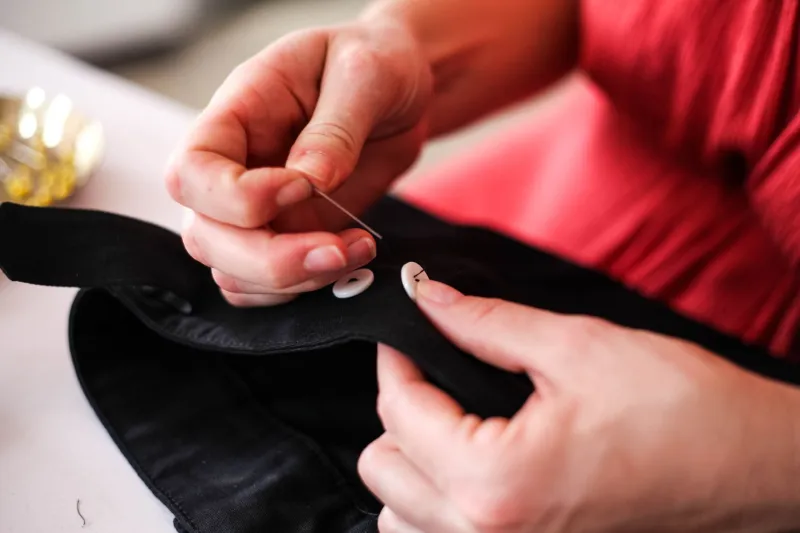
Let's start with what the fashion industry needs you to believe: that clothes are finished objects. That they arrive from the store or the warehouse or the brand's website in their final, correct form, and your job is to select the right finished object for your body and your life and your identity. The industry is very good at selling this idea. It has an entire infrastructure — sizing systems, trend cycles, the concept of "the right fit" as something you find rather than something you make — devoted to keeping you in the role of consumer rather than creator.
Now let's talk about what a seam ripper costs. About three dollars.
The Alteration Is the Point
Somewhere between the explosion of YouTube tutorials and the quiet proliferation of underground sewing circles, a movement has been building that the fashion industry genuinely doesn't know how to absorb. It's not anti-consumption in the boycott sense — most of the people doing this are still buying clothes. It's something more specific and, in its way, more threatening: the decision to treat a purchased garment as raw material rather than finished product.
Taking in a waist. Cropping a hem. Converting a boxy thrifted blazer into something that actually fits a specific human body that doesn't conform to the sample size it was cut for. These are old skills — genuinely ancient skills — that the ready-to-wear industry spent the twentieth century convincing us were unnecessary. Why learn to alter when the store has your size? (Except the store often doesn't have your size, or the size exists but the cut is wrong, or the fit is fine but the piece isn't quite yours yet.)
The people coming back to these skills aren't doing it because they have to. They're doing it because they've figured out that the ability to modify a garment is a form of autonomy that money can't easily replicate.
Learning in Public, Together
Jamila runs a biweekly sewing circle out of a community space in East Oakland. She started it two years ago with four friends and a pile of thrifted clothes that didn't quite fit anyone. It's grown, inconsistently and beautifully, to anywhere between ten and twenty-five people on a given night, ranging from total beginners to people who've been sewing for decades.
"The thing I didn't expect," she says, "was how political it would feel." She laughs. "I mean, we're just hemming pants. But there's something that happens when you realize you can fix this yourself. That you don't have to go buy a new thing. That this thing you own can become what you need it to be."
The circle operates on a share-everything basis: machines, thread, tools, knowledge. Someone knows how to do a blind hem, someone else figures out how to take in a shirt's side seams, someone brings a tutorial they found online and they work through it together. The learning is communal and slightly chaotic and, by every account, deeply satisfying in a way that buying a new piece of clothing almost never is.
"There's a guy who comes," Jamila says, "who told me he'd never sewn anything in his life. He came because his jeans never fit right — his waist is one size and his hips are another, and he's just spent his whole life accepting that clothes don't fit him. First night, we taught him to take in a waistband. He looked like someone had handed him a superpower."
The YouTube Generation Picks Up a Needle
For people who don't have a Jamila in their city, the internet has filled the gap in ways that would have been unimaginable a generation ago. YouTube channels devoted to tailoring and garment alteration have audiences in the hundreds of thousands. Some of them are technical and precise, aimed at people who want to learn properly. Others are chaotic and experimental — someone with a thrift store blazer and a lot of confidence trying things and narrating what happens.
Both kinds are useful. Both kinds are, in their different ways, acts of knowledge-sharing that the fashion industry would prefer didn't exist at scale.
Kevin, 26, learned to alter clothes almost entirely from YouTube during the pandemic. "I had time and I had a bunch of clothes that didn't fit right and I had nothing to lose," he says. He started with basic hemming, moved to taking in shirts, and eventually started doing more significant reconstructions — cutting down oversized thrifted pieces, combining elements from different garments, making things that don't have a direct retail equivalent.
"The first time I made something that was genuinely mine — like, it didn't exist before I made it — that felt different from anything I'd bought," he says. "You can't replicate that feeling by buying the right brand. The brand didn't make this. I made this."
What Corporate Construction Is Actually Built For
Here's something the alteration community will tell you quickly: most mass-produced clothing is built to be difficult to alter. Not intentionally, not as a conspiracy — but the combination of synthetic fabrics, narrow seam allowances, fused interlinings, and construction shortcuts that make fast fashion cheap also make it resistant to modification. There's not enough fabric in the seams to let something out. The material frays badly when you try to rework it. The structure falls apart if you remove the elements holding it together.
This is, functionally, a form of planned obsolescence. The garment is built to be replaced, not repaired or remade. Learning to identify which pieces have enough seam allowance to work with, which fabrics will hold a new stitch, which construction methods are reversible — this is knowledge that makes you a more dangerous consumer. You start to see the built-in limitations as what they are: a system designed to keep you buying rather than keeping.
"I look at clothes completely differently now," says Priscilla, a 33-year-old in Austin who started altering after getting frustrated with how nothing in her size fit the way she wanted. "When I'm in a store or looking at something secondhand, I'm thinking about the seams. Is there enough there to work with? What's the fabric? Could I make this into what I actually want?" She pauses. "It changes your relationship to the whole thing. You stop being a passive recipient and start being someone who makes decisions."
The Radical Act of Enough
There's a reason the fashion industry pushes the idea that altering and mending are either quaint hobbies or poverty-adjacent necessities. If significant numbers of people start treating purchased garments as starting points rather than endpoints, the consumption model gets complicated. You buy less. You keep things longer. You extract more value from what you already own. You develop skills that reduce your dependence on the cycle of buying new.
None of this requires a manifesto. You don't have to frame picking up a needle as a political act for it to function as one. The politics are in the practice: the slow, tactile, deeply personal process of making something yours by working on it with your hands.
The fashion system is built on the idea that you need it. That without the next drop, the next season, the next brand telling you who you are, you're lost. Learning to alter your own clothes is a quiet, durable argument against that premise. It says: I have what I need. I can make it work. I don't need your version of finished.
Three dollars for a seam ripper. The rest is yours.