The Mend Is the Message: Why Fixing Your Clothes in Public Is a Political Act

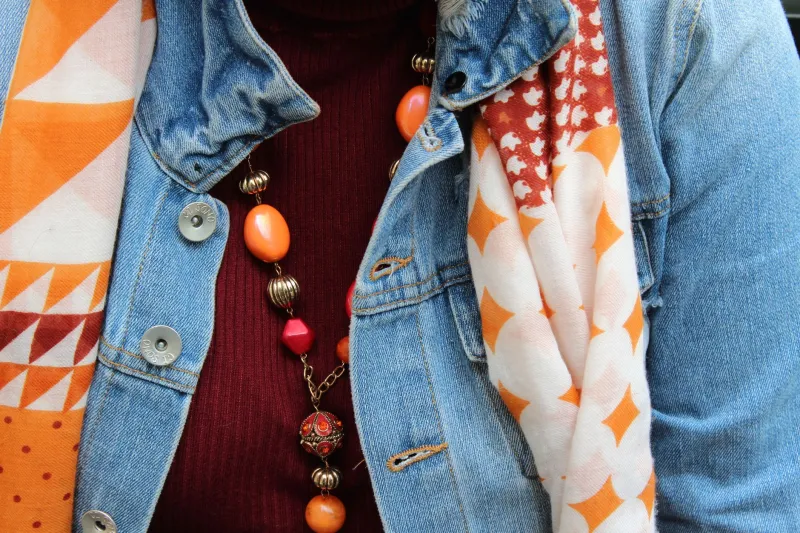
Photo by Photo by Barbara Krysztofiak on Unsplash on Unsplash
Somewhere in a Chicago apartment, Dani is finishing a repair on a pair of thrifted Levi's. The knee blew out months ago — a clean split along a stress line that had been building since before she owned them. She's not hiding it. The patch is a deep rust-colored linen, stitched on with a running stitch in bright yellow thread that follows the grain of the fabric in loose, visible lines. When she's done, the repair will be the first thing you notice about the jeans. That's the point.
"I used to try to make repairs invisible," she says. "Then I realized that the whole idea of invisible repair is about shame. Like the damage is something to be embarrassed about. I'm not embarrassed. This pair of jeans has a history. I want it to show."
This is visible mending — the practice of repairing clothes not just to extend their life but to make the repair itself part of the garment's story. It's been growing quietly for years, and right now it's having a moment that feels less like a trend and more like a reckoning.
From Hidden Stitch to Loud Seam
The traditional goal of clothing repair was invisibility. A good tailor could close a tear so cleanly you'd never know it was there. The logic was straightforward: damage was a flaw, and flaws should be erased. This made sense in a world where clothes were expensive and scarcity was real — you repaired things because you had to, and you hid the repair because visible damage signaled poverty.
But the visible mending movement flips that logic entirely. Its practitioners are choosing to make the repair the most visible part of the garment — using contrasting thread, bright patches, decorative stitching techniques like sashiko (a Japanese quilting method that creates geometric patterns through running stitches) to transform the site of damage into a focal point.
The shift isn't just aesthetic. It's philosophical. Hiding damage treats wear as failure. Showing it treats wear as evidence — of use, of time, of a garment that has actually meant something to someone.
The Garment as Artifact
There's a concept in Japanese aesthetics called wabi-sabi — an appreciation for imperfection and transience, for the beauty found in things that are worn, weathered, and incomplete. It's related to kintsugi, the practice of repairing broken pottery with gold lacquer so the break becomes a feature rather than a blemish. Visible mending is, in a lot of ways, kintsugi for your wardrobe.
But it's also something more specifically American in the way it's being practiced right now. Because in the US, the decision to repair rather than replace is happening against a backdrop of a fashion industry that has spent decades conditioning people to treat clothes as disposable. Fast fashion made replacement cheaper than repair. It made newness the only metric of value.
Visible mending rejects that metric completely. It says: this garment is worth keeping not despite its history but because of it. It says: I am not a consumer moving through product cycles. I am a person with a relationship to the things I own.
Marco, a textile artist in Portland who runs community mending workshops, puts it this way: "When you repair something yourself, you learn the structure of it. You understand how it was made. That knowledge changes your relationship to everything you wear. You stop seeing clothes as things that happen to you and start seeing them as things you participate in."
The Sustainability Argument (And Why It's Bigger Than That)
The environmental case for visible mending is straightforward. The fashion industry is one of the largest contributors to global waste. Americans throw away roughly eighty pounds of clothing per person per year. Extending the life of a garment — even by a few years — meaningfully reduces that impact. Repair is, in purely material terms, one of the most effective things an individual can do.
But the practitioners of visible mending will tell you that sustainability, while real, isn't the whole story. The practice is also about reclaiming a relationship to material objects that consumer culture has systematically destroyed.
"There's a skill involved in making clothes last," says Yolanda, a seamstress in Atlanta who started sharing her repairs on social media after her followers kept asking about the patches on her jacket. "That skill used to be universal. Everybody's grandmother knew how to darn a sock. We gave that up when we decided that new was always better. Getting it back feels like getting something of yourself back."
That sense of reclamation runs through almost every conversation about visible mending. It's about ownership in the deepest sense — not legal ownership, but the sense that you understand and can care for the things in your life. In a world designed to make you dependent on systems and supply chains, the ability to fix what's broken is a small but genuine form of independence.
What Your Clothes Remember
Here's what happens when you repair something visibly: the garment becomes a record. The patch from the year you moved apartments. The sashiko stitching you learned from a YouTube video during a particularly bad winter. The place where you caught your sleeve on a fence at a protest and someone you barely knew helped you pin it back together in the cold.
Clothes already hold memory — we all have pieces we can't get rid of because they're too tangled up with who we were when we wore them. Visible mending makes that memory legible. It turns the garment into something closer to a journal than a product.
That's the luxury the fashion industry can't replicate, no matter how much it charges. You can't manufacture history. You can't pre-distress meaning into a garment. The story has to be lived into the fabric, one repair at a time.
So pull out the thread. Pick a color that doesn't match. Let the stitch show. Your broken clothes aren't a problem to be solved — they're a history worth keeping, and none of us should be in the business of hiding what we've been through.