Soft Serve: How Athleisure Sold You Rebellion and Delivered a Leash
There's a particular kind of genius in making a cage feel like a cloud. You stop rattling the bars. You stop noticing the bars. Eventually, you forget bars were ever part of the picture.
That's more or less what happened with athleisure.
Somewhere between 2012 and now, the American wardrobe underwent what the industry called a "revolution." Blazers got replaced by bomber-weight zip-ups. Jeans got swapped for joggers. Heels gave way to chunky foam-soled sneakers that cost more than most people's rent checks. The pitch was simple and seductive: wear what feels good. Dress for your body, not for some imaginary boardroom. Liberate yourself from the performance of dressing up.
And it worked. God, it worked. Lululemon is worth more than $40 billion. Athleisure now accounts for a significant slice of the entire U.S. apparel market. The sweatpant is no longer a sign of giving up — it's a status symbol. Your $128 joggers are doing a lot of heavy lifting, socially speaking.
But here's the question nobody's really asking: liberated into what, exactly?
The Comfort Industrial Complex
Let's back up. The rise of athleisure wasn't some organic grassroots movement where regular people finally said enough and started showing up to work in their gym clothes. It was a market opportunity, engineered and executed by some of the most sophisticated brand machines on the planet.
Nike, Lululemon, Alo, Vuori, Outdoor Voices — these aren't scrappy underdogs. They're corporations with massive marketing budgets, influencer armies, and a very clear understanding of consumer psychology. And what they figured out is that if you can make someone feel like their purchasing decision is an act of self-care, you've essentially made the sale invisible. It doesn't feel like buying. It feels like choosing yourself.
That's the sleight of hand. Comfort got rebranded as consciousness. Softness became a value system. And a very specific aesthetic — muted tones, minimal logos, body-skimming silhouettes, the whole "quiet luxury meets gym rat" vibe — became the visual language of a particular kind of aspirational American identity.
The identity that's too evolved for fashion. The identity that's above all that.
Except you're still buying. You're still consuming. You're still performing — just in a different costume.
What Gets Lost When Nothing Chafes
Here's something worth sitting with: a lot of the most interesting things humans have ever done with clothing involved some degree of friction. Not physical friction, necessarily, but social friction. The zoot suit. The leather jacket. The safety pin through the lapel. The BDSM-inflected runway looks that made network news anchors visibly uncomfortable in the '90s.
Dress has historically been one of the cheapest and most accessible ways to signal that you are not going along with the program. You don't need a platform or a following or a trust fund. You just need to walk into a room wearing something that makes people do a double-take.
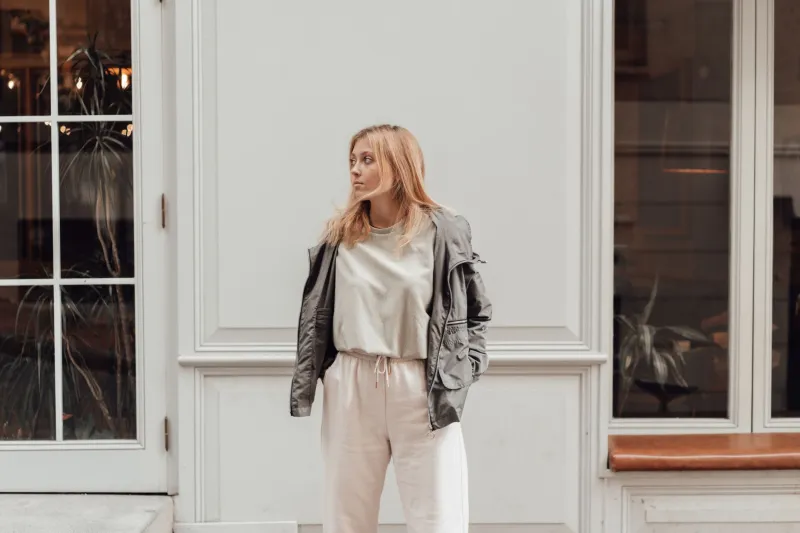
Athleisure, almost by design, eliminates that possibility. It is the clothing of going along. Of blending. Of occupying public space without disturbing it. When everyone from the finance bro to the yoga instructor to the stay-at-home parent is wearing the same palette of oat, sage, and slate, the look stops communicating anything at all. It becomes visual white noise.
And visual white noise is very, very convenient for the people who'd rather you not make too much noise in general.
There's a reason the most aggressively "comfortable" era in American fashion history coincides with a period of extraordinary political and social upheaval. It's not a conspiracy exactly — it's more diffuse than that. But the effect is real: when your clothes ask nothing of you, when they generate no friction and carry no message, it becomes a little easier to move through the world without engaging with it.
You're cozy. You're cushioned. You're fine.
The New Conformity Doesn't Look Like Conformity
The cleverest thing about athleisure as a social force is that it's packaged its conformity as individuality. The brands will tell you that their leggings are designed for your body. Their color palette is "intentional." Their fabric technology is about your performance, your recovery, your wellness journey.
It's all relentlessly first-person. And yet somehow, everyone ends up looking the same.
Walk through any major American city on a Saturday morning. Farmers market, coffee shop, dog park — doesn't matter. You'll see the same uniform repeated with minor variation. The cropped quarter-zip. The high-waisted legging. The oversized hoodie in a color that's technically a color but barely. The chunky white sneaker. Maybe a baseball cap, also in something technically a color but barely.
This is not a coincidence. The brands have converged on this aesthetic because it sells, and it sells because it asks so little of the wearer. There's no commitment required. No statement being made. No risk. You can't be wrong in athleisure, which also means you can't really be right in it either.
You're just... present. Physically present, emotionally unavailable, sartorially inoffensive.
That's the new conformity. It doesn't look like the gray flannel suit. It doesn't feel restrictive. It feels like freedom. That's what makes it so effective.
Dressing Against the Numbness
None of this means you need to go put on a corset and suffer for your principles. Comfort isn't the enemy. Your body deserves to not be in pain. That's not the argument.
The argument is about intentionality. About whether your clothes are saying something or saying nothing. About whether you're using what you put on your body as a tool — for self-expression, for community, for resistance — or whether you've outsourced that decision to a corporation that profits from your passivity.
Because here's what the athleisure boom doesn't want you to notice: the most radical thing you can do with your wardrobe right now is mean something. Wear something that takes a position. Dress in a way that requires explanation, or invites a conversation, or signals allegiance to something other than a brand's lifestyle aesthetic.
It doesn't have to be loud. It can be a patch. A pin. A thrifted piece with actual history on it. A DIY alteration that makes something mass-produced into something specific to you. A graphic that says what you actually think instead of what Alo Yoga thinks you should think about yourself.
The brands want you soft, smooth, and interchangeable. They want you to feel like you've opted out of the performance of fashion while still buying into it, literally, every season.
Don't give them the satisfaction of the numb.
Wear something that wakes you up a little. Even if it's just you who notices.