Fury as Raw Material: The Independent Designers Building Brands From the Inside Out
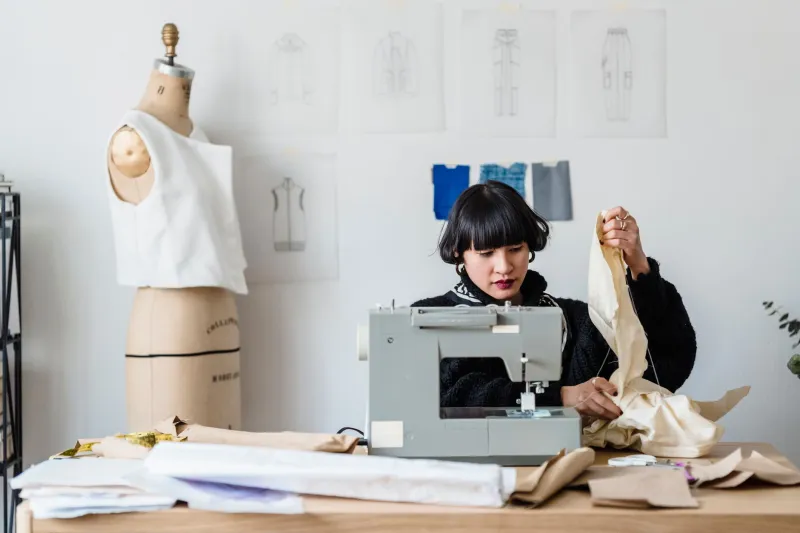
Forget the mood board. Forget the trend forecast. Forget the investor deck with the projected growth curves. Some of the most interesting fashion being made in the US right now started not with a business plan but with a feeling — specifically, the feeling that something is deeply, structurally, personally wrong, and that making things with your hands is one way to do something about it.
We talked to designers across the country who are building brands on the back of specific grievances. Not vague "activism-adjacent" messaging. Not a recycled tote bag with a slogan. Real, rooted fury — the kind that comes from lived experience — translated into design decisions, manufacturing ethics, and brand identity. Here's what they're making, and why.
Tanya Reeves — Stitching Back Against the Size Industrial Complex
Tanya Reeves started sewing her own clothes at 16 because the fashion industry had made it clear her body wasn't its problem. Based out of Atlanta, she now runs Wide Angle Collective, a small-batch label that makes structured, fashion-forward pieces in sizes 0 through 30 — with no "extended size" section, no separate line, no asterisk.
"The thing that made me angriest wasn't that plus-size fashion was ugly," she says. "It was that the industry kept acting like making clothes for fat people was a favor. Like we should be grateful for the polyester tent they threw at us."
Every Wide Angle piece is made to the same pattern quality regardless of size. Reeves works with a small production team in Georgia and refuses to scale up in ways that would compromise her fit standards. She's turned down two acquisition conversations with larger brands. "The minute I let someone else control the sizing grading, I lose the whole point."
Her Instagram bio reads: Made for the body you have. Not the one they wanted you to have.
Marcus Osei — Labor Visibility as Design Language
Marcus Osei grew up watching his mother work double shifts at a garment factory in Los Angeles. He started Documented, a streetwear label, as a direct response to the fashion industry's habit of hiding its supply chain behind aspirational branding.
Every Documented piece includes a QR code sewn into the lining that links to a page naming the workers who made it, their pay rate, and the facility conditions. It's not a gimmick — Osei worked with labor advocates to develop a transparency framework before he ever cut a single piece of fabric.
"Fashion loves to talk about heritage and craft and authenticity," he says, "but the second you ask who made the shirt and what they got paid, suddenly it's complicated. I wanted to make that question impossible to avoid."
Documented runs on a made-to-order model, which keeps waste down and keeps Osei from having to chase wholesale minimums that would compromise his production ethics. Growth has been deliberate and slow. He's fine with that. "I'd rather have 500 customers who actually understand what they're holding than 50,000 who just think the logo is cool."
Priya Nair — Environmental Grief Turned Inside Out
Priya Nair describes the founding of her label Residue as "a direct response to watching California burn."
Based in Oakland, Nair makes upcycled outerwear from reclaimed industrial fabrics — deadstock, salvaged workwear, surplus military materials. Each piece is one-of-a-kind. None of it will ever be restocked. That's the point.
"I couldn't keep making new things in a world drowning in stuff," she says. "Every piece I make is a piece that didn't have to be manufactured. That's the whole design philosophy."
Residual's aesthetic is deliberately unglamorous — utilitarian, heavy, built to last decades. Nair teaches repair workshops out of her studio and offers free alterations for life on every garment she sells. She's openly skeptical of the "sustainable fashion" branding that larger companies have adopted. "Sustainability isn't a marketing category. It's a practice. You can't slap it on a hang tag and call it done."
Deja Williams — Cultural Erasure and the Reclamation of Black Aesthetics
Deja Williams has a specific grievance: watching Black aesthetics get lifted by mainstream fashion with zero credit, zero compensation, and zero acknowledgment.
"They'll put cornrow-inspired patterns on a runway in Paris and call it 'geometric.' They'll sell durags as 'hair accessories' for $80. And the communities those things came from see none of it."
Her Brooklyn-based label Lineage is built explicitly around attribution and community economics. Every collection is developed in collaboration with artists and craftspeople from specific Black cultural traditions — and those collaborators are credited, paid, and given equity in the pieces they help create.
"Attribution isn't just about giving credit," Williams explains. "It's about who gets to build wealth from culture. I'm not interested in a brand that extracts. I want one that circulates."
Lineage sells direct-to-consumer and actively avoids retail partnerships that would dilute her control over the brand narrative. Growth is community-funded — she's run two successful crowdfunding campaigns to expand production without taking on outside investors.
Eli Montoya — Queerness, Safety, and the Politics of the Visible Body
Eli Montoya started making clothes after a friend was harassed for wearing gender-nonconforming clothing in public. Based in Chicago, their label Signal Flare is designed specifically for queer and trans wearers who want to be visible on their own terms — not invisible for safety, not performing visibility for straight audiences.
"There's this impossible ask we put on queer people," Montoya says. "Either hide yourself or perform yourself for someone else's comfort. I wanted to make clothes that were just — ours. Not explained. Not translated."
Signal Flare's pieces use construction and silhouette to disrupt conventional gendered dressing without making a spectacle of it. The brand also donates 15% of every sale to queer youth shelters in the Midwest. Montoya is transparent about the tension between visibility and safety that runs through every design decision.
"Sometimes the most radical thing is a pocket in the right place. Sometimes it's a silhouette that says 'I don't owe you legibility.' Both are valid."
The Real Cost of Staying Small
Every designer we spoke to has faced some version of the same pressure: scale up, reach more people, take the meeting, accept the investment. And every one of them has had to decide, over and over, whether growing the brand would mean losing what made it worth building.
The tension is real. A message-driven brand that stays small reaches fewer people. But a message-driven brand that scales without guardrails often becomes the thing it was fighting against — another company with good copy and compromised practices.
What these designers share isn't a single answer to that problem. It's a refusal to pretend the problem doesn't exist. They're building in public, showing their receipts, naming their constraints, and making things that mean something — even when, especially when, the industry would rather they didn't.
That's not a business model. It's a practice. And it's making some of the most honest clothes in America right now.
None Of Us is here for the builders, the stitchers, and the people who make things with something to say. Wear your resistance.