Distressed at $400: When Runways Start Copying Calluses
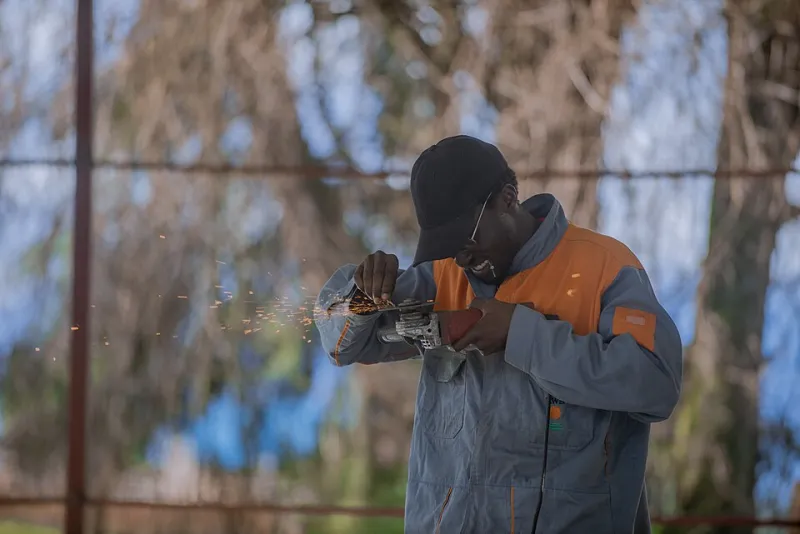
Photo: Adygrafix250, CC BY-SA 4.0, via Wikimedia Commons
There's a jacket hanging in a design studio somewhere right now that looks exactly like the one hanging in Ray Delgado's locker. Except Ray's has the sparks burns in it for real, one for roughly every shift he's worked at the fabrication shop outside Houston for eleven years. The studio version has its burns applied by machine, aged by chemicals, and priced at a number Ray describes, accurately, as "more than my truck payment."
Ray is a welder. He is also, without his consent or compensation, a muse.
What the Work Actually Does to the Clothes
Talk to people who work with their bodies and you hear the same inventory, itemized with a specificity no runway styling could fake.
The roofers: knees gone first, always. Shingles shred pant legs at exactly the height where a knee rests on hot asphalt, so a real roofer's pants tell you their trade from across a job site. The line cooks: forearms speckled with grease freckles, aprons starched into armor by a thousand wash cycles, shoes that have absorbed so much fryer oil they've become a different material. The farmworkers: sleeves bleached by sun to a shade that doesn't exist in any dye lot, hands that have reshaped every pocket on their jeans into something between a tool holster and a pouch.
None of this is styling. All of it is physics. And that's precisely what the fashion industry keeps failing to copy — or refusing to understand.
The Distressing Machine
The technique of pre-destroying clothing is old news. What's newer is the scale and the shamelessness. Premium brands now sell "authentic workwear patina" — sandblasted denim, laser-etched whiskers, factory-applied grease at the pocket edges. Some of these processes are done by actual workers, in actual factories, inflicting simulated wear so that garments can look like they survived labor that never happened.
It's a strange loop: human beings paid little to hand-age clothing that will be sold, for hundreds of dollars, to people who will never kneel on a hot roof. The distress is severed from the labor, then the labor is severed from the distress, and what's left is a costume of endurance for people shopping for one.
"They're buying the story without the shifts," as Ray put it. "The jacket doesn't mean anything if you didn't get burned in it."
What the Workers Say
We asked a handful of people whose clothing carries real evidence how they felt about the aesthetic. The answers ranged from amused to furious.
A line cook in Portland told us she finds it "hilarious and insulting in equal measure — I can't afford a $300 'distressed' apron, and also, why would you want a fake one? The real ones smell like a Saturday night."
A third-generation farmer in Iowa was more blunt: "Those jeans got wrecked by somebody getting paid to wreck them, and mine got wrecked feeding you. We are not the same product."
And a roofer in Florida had the most practical take: "If they want the look so bad, come do a week. We're hiring."
The Version You Can Actually Wear
Here's the thing — the honest alternative already exists, and it's not a $400 simulation. It's a $40 pair of genuine work pants from the same suppliers the trades have used for decades, bought new and worn into authenticity by your own life. It's thrifted carpenter jeans that already did time. It's letting your clothes meet your actual days instead of purchasing a counterfeit of somebody else's.
You cannot buy patina. You can only earn it, slowly, in the specific conditions of your specific life. That's the part no brand can manufacture, no matter what the machine that burned Ray's jacket shape into denim would like you to believe.
The workers already did the work. The least the rest of us can do is stop pretending we did.