Gray Area: How Wearing Nothing in Particular Became the Loudest Statement in the Room
There's a version of minimalism that gets sold back to you through $400 linen sets and "capsule wardrobe" guides sponsored by the exact brands you're supposedly escaping. That's not what we're talking about here. We're talking about something harder to market, harder to photograph, and — maybe because of both those things — genuinely threatening to the attention economy that fashion runs on.
We're talking about people who've stripped their wardrobes down to near-invisibility on purpose. Not because they can't afford better. Not because they don't care. Because caring, loudly, in the way the culture demands, started to feel like a trap.
The Visibility Economy Wants Your Whole Chest
The logic of contemporary fashion — fast, slow, luxury, streetwear, all of it — operates on one shared assumption: you should be seen. Your clothes are a broadcast signal. They communicate your tribe, your taste level, your politics, your income bracket, your irony quotient. The whole system depends on legibility. On you being readable.
And for a long time, resistance to that system expressed itself through more visibility, not less. Louder graphics. Weirder silhouettes. Statement pieces that announced your refusal to comply. Which is fine. Some of that is genuinely subversive. But there's a problem: the machine learned to eat it. Every "anti-fashion" moment gets absorbed, packaged, and resold within eighteen months. The safety pin becomes a luxury accessory. The protest tee gets a runway moment. The underground aesthetic gets a Target collaboration.
So what happens when a growing number of people decide that the only move the machine can't commodify is the move that produces nothing worth photographing?
Profiles in Gray
Marcus, 34, works in logistics in Columbus, Ohio. For the past three years, his wardrobe has consisted of dark-wash jeans, plain crewneck sweatshirts in charcoal and navy, white and gray tees, and one pair of clean white sneakers he replaces annually. No logos. No graphics. No statement pieces. Nothing that would get a second glance on the street or register as intentional in any direction.
"I used to spend real money on clothes," he says. "Trying to look like I had a point of view. And I did have one — I just kept buying someone else's version of it." The shift wasn't about saving money, though that happened too. It was about noticing that the effort of being visually legible was exhausting in a way he couldn't quite name. "Every morning was a performance. Now it's not. I just get dressed."
What's interesting about Marcus isn't the wardrobe itself — it's what the wardrobe does. In a culture where your outfit is supposed to tell people who you are before you open your mouth, showing up in nothing in particular is a kind of refusal. You don't get to pre-read him. You have to actually talk to him.
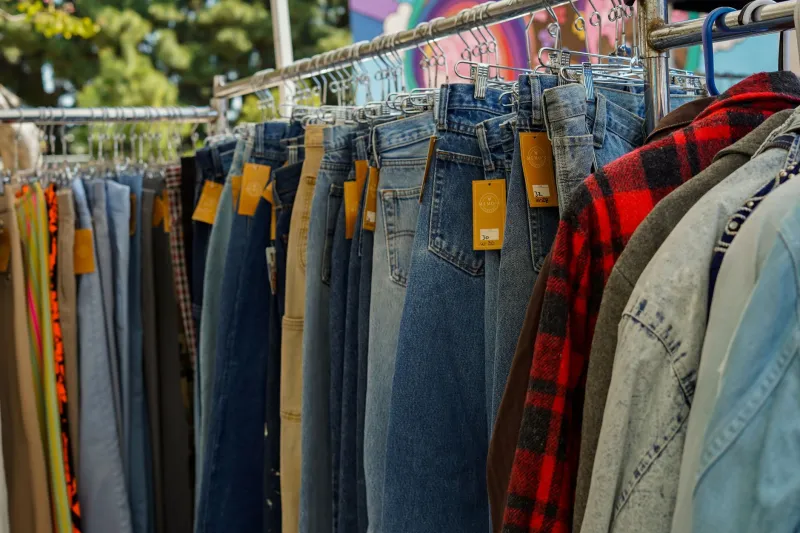
Then there's Deja, 28, a graphic designer in Atlanta who describes her current style as "actively boring." She's precise about the distinction. "Boring by accident means you don't care," she says. "Boring on purpose means you made a decision." Her wardrobe is almost entirely secondhand, almost entirely neutral, and almost entirely indistinguishable from a hundred other people on the street. Which, she argues, is the point. "I'm not a brand. I'm not a mood board. I'm a person. I got tired of dressing like a content strategy."
The Paradox Nobody Wants to Talk About
Here's the uncomfortable thing: the deliberate rejection of personal branding has, inevitably, become its own recognizable aesthetic. Search "stealth wealth" or "quiet luxury" and you'll find approximately ten thousand articles, Pinterest boards, and TikToks devoted to the art of looking like you're not trying. The irony is almost too clean.
But there's a real difference between the luxury version of this — which is still deeply invested in signaling, just signaling money rather than taste — and the version Marcus and Deja are describing. The luxury quiet is expensive quiet. It's still legible if you know the codes. A $900 cashmere crewneck reads as a crewneck to most people and as a flex to exactly the right people. That's not invisibility. That's exclusivity with plausible deniability.
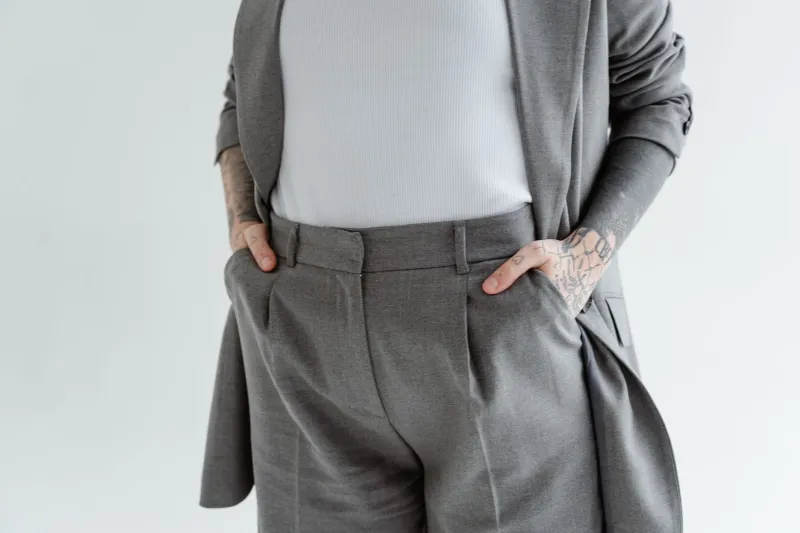
What the people we're talking to are after is something less glamorous and more genuinely destabilizing: the refusal to signal anything. Not wealth, not politics, not subculture, not aspiration. Just a body in clothes that function. The goal isn't to look rich in a subtle way. The goal is to be unreadable.
What You're Saying When You Say Nothing
There's a long history of strategic plainness as resistance. Quakers wore undyed, unadorned clothing as a rejection of social hierarchy — your clothes told people your class, and theirs refused to. Some labor organizers in the early twentieth century adopted deliberately nondescript dress to move through spaces without being identified. Certain activist traditions have long understood that invisibility is a form of protection.
The contemporary version isn't usually about safety in the same direct sense (though for some people, especially people of color navigating spaces where being visually coded as "threatening" or "other" carries real stakes, the calculus is more complex). For most of the people we talked to, it's about something subtler: the refusal to participate in the constant performance of self that digital culture has made mandatory.
When everything is content and everyone is a brand, the person who declines to produce a readable aesthetic is doing something genuinely strange. They're not giving the algorithm anything to work with. They're not giving the stranger on the subway a quick shorthand. They're not giving the brand a consumer identity to target. They're just there, in clothes, being a person.
The Curation Inside the Anti-Curation
None of this is accidental, and that's what makes it interesting rather than just sad. The people doing this are, in almost every case, intensely deliberate about it. Deja can tell you exactly why she chose a specific shade of stone-colored chino over another. Marcus has strong opinions about the weight of cotton he'll wear. The wardrobe is minimal, but the thought behind it isn't.
That's the paradox that the visibility economy can't quite process: a perfectly curated statement that refuses to be a statement. You can't screenshot it. You can't tag it. You can't buy the look because the look is the absence of a look.
And in a moment when every form of aesthetic resistance gets turned into a product within months, that might be the most durable form of refusal available. Not because it's pure — nothing is pure — but because it's genuinely difficult to sell nothing.
Wear your resistance, sure. Sometimes that means wearing the loudest thing in the room. And sometimes it means wearing something so quiet that the whole noise machine has nothing to grab onto.
Gray is a color. Silence is a sound. And opting out of being legible is, in its own stubborn way, a position.